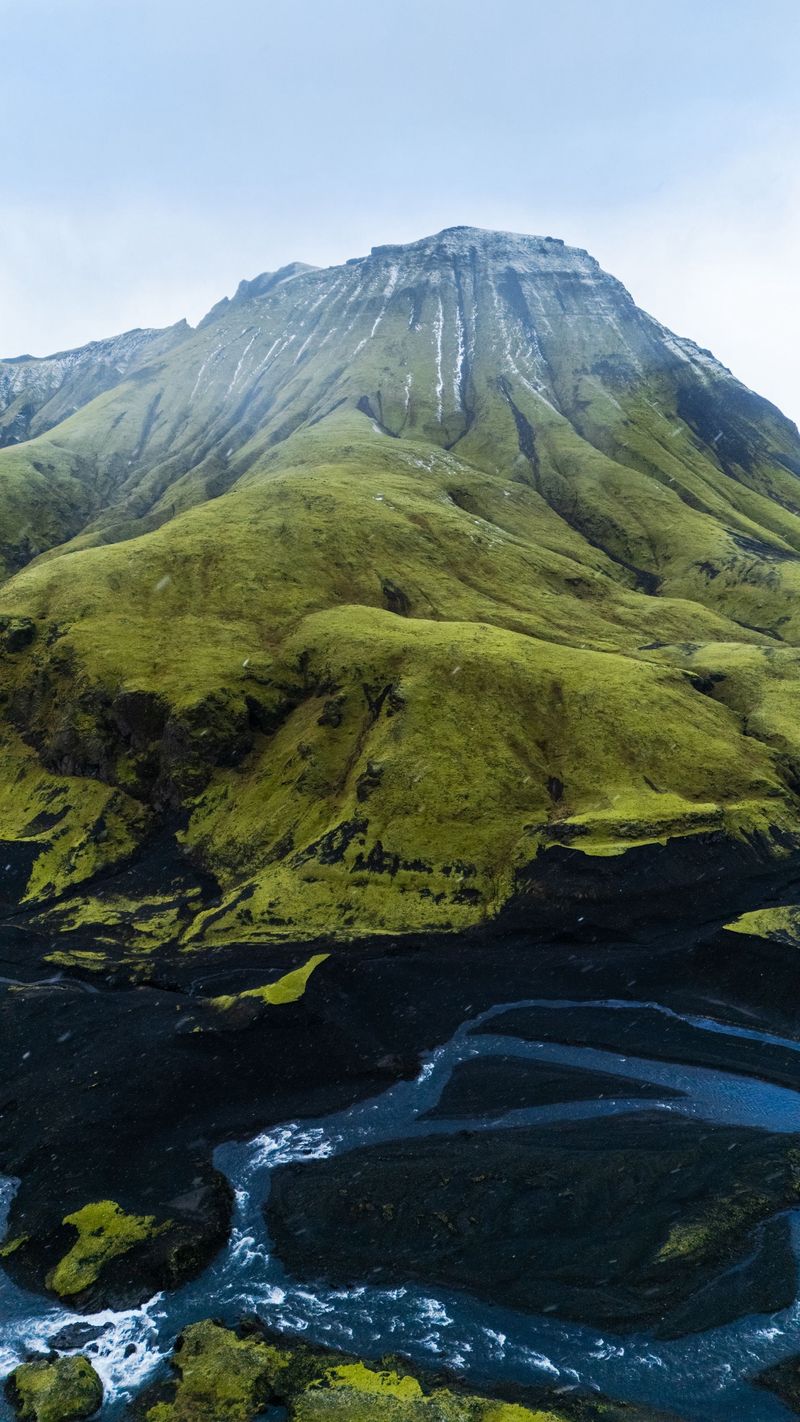
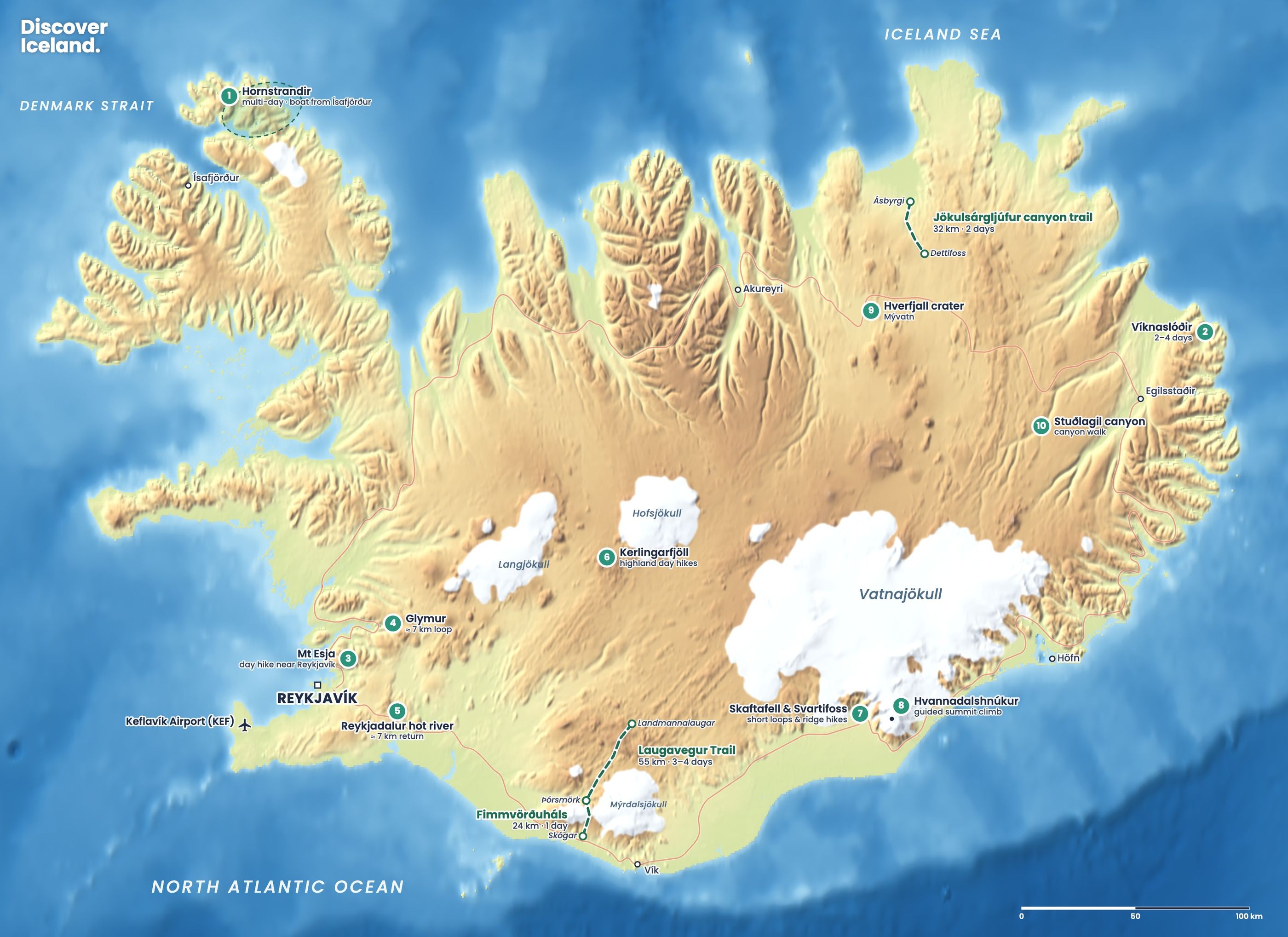
Hiking in Iceland ranges from a 20-minute walk to a waterfall to four days across the highlands with your bed on your back. The best-known trek is the 55 km Laugavegur Trail from Landmannalaugar to Þórsmörk. The best day hikes include Skaftafell, Glymur, Mount Esja, Reykjadalur and the colourful mountains around Landmannalaugar. Most highland trails open only from late June to mid-September, while many lowland walks work all year.
This guide covers the best hikes by length, when to go, how to reach the trailheads, where to sleep and how to stay safe.
What are the best hikes in Iceland?
The best hikes in Iceland are the Laugavegur Trail, the day trails around Landmannalaugar and Skaftafell, Glymur, and the canyon trail from Ásbyrgi to Dettifoss. For an easy start, the walks to Svartifoss and the Reykjadalur hot river are hard to beat. The table gives a quick comparison.
| Hike | Region | Distance | Time | Level |
|---|---|---|---|---|
| Laugavegur Trail | Southern highlands | 55 km | 3–4 days | Challenging |
| Ásbyrgi to Dettifoss | North, Vatnajökull NP | 32 km | 2 days | Challenging |
| Fimmvörðuháls | South, Skógar to Þórsmörk | About 25 km | 1–2 days | Challenging; see warning below |
| Bláhnúkur | Landmannalaugar | About 4 km | About 3 h | Moderate, steep |
| Glymur loop | Hvalfjörður, west | About 7 km | 3–4 h | Moderate, exposed |
| Svartifoss–Sjónarsker–Sel | Skaftafell | 5.8 km loop | About 2 h | Easy |
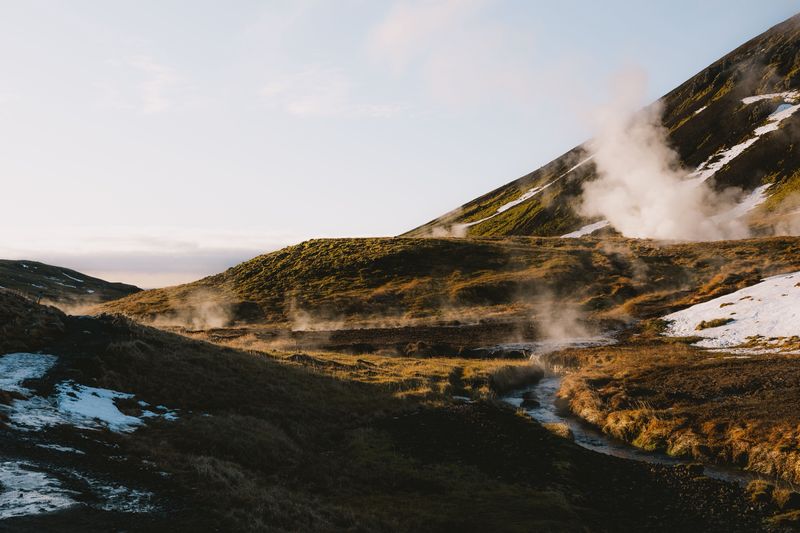
| Reykjadalur hot river | Hveragerði | About 7 km return | 2–3 h with a bath | Easy to moderate |
| Hengifoss | East Iceland | About 2 h return | About 2 h | Moderate, 300 m climb |
Times are walking times in good conditions. In wind, rain or fog, add time, and turn back early rather than late.
When is the hiking season in Iceland?
The main hiking season in Iceland runs from late June to mid-September. That is when the highland roads are open, the buses run and the mountain huts are staffed. Ferðafélag Íslands (FÍ), the Iceland Touring Association, gives the Laugavegur Trail an average open season of 25 June to 15 September, though the exact dates depend on snow and when the roads open.
Lowland trails are different. Skaftafell, Reykjadalur, Þingvellir and the waterfall walks along the south coast can be hiked all year. In winter they are often icy, the days are short and some paths close for repairs or to protect the ground in the spring thaw. July and August give the most reliable trail conditions and almost endless daylight. Our guide to the best time to visit Iceland covers the weather month by month.
What are the best multi-day treks in Iceland?
The best multi-day treks in Iceland are the Laugavegur Trail, the canyon trail from Ásbyrgi to Dettifoss, and the coastal routes of the Hornstrandir nature reserve. Fimmvörðuháls is a classic one or two-day crossing, but it is under a safety warning as of autumn 2026.
Laugavegur Trail
The Laugavegur runs 55 km from the hot springs of Landmannalaugar to the green valley of Þórsmörk. Most people take four days, sleeping in FÍ huts or campsites at Hrafntinnusker, Álftavatn or Hvanngil, and Emstrur. You cross rhyolite mountains, obsidian fields, black sand deserts and at least three rivers you must wade. Our Laugavegur Trail guide has every stage, hut and bus.
Fimmvörðuháls
Fimmvörðuháls climbs about 1,000 m from Skógafoss to a pass between the Eyjafjallajökull and Mýrdalsjökull glaciers, then drops into Þórsmörk. On the way you pass the Magni and Móði craters from the 2010 eruption. On 25 August 2026 FÍ, Útivist and the Dagrenning rescue team strongly advised against crossing it, because glacier retreat had opened ravines and crevasses near the huts on the pass. Read our Fimmvörðuháls guide before you plan it.
Ásbyrgi to Dettifoss
In the north of Vatnajökull National Park, a 32 km trail follows the Jökulsárgljúfur canyon from the horseshoe-shaped Ásbyrgi to Dettifoss. The park recommends two days, with a night at the Vesturdalur campsite. There are no huts, and camping is allowed only at the official sites at Ásbyrgi, Vesturdalur and Dettifoss. The middle stage includes wading the Stallá river.
Hornstrandir
Hornstrandir, at the northern tip of the Westfjords, has no roads at all. Boats from Ísafjörður, Bolungarvík and Norðurfjörður drop hikers off between June and August. It has been a nature reserve since 1975 and is one of the best places in Iceland to see Arctic foxes. Book your return boat in advance, because that is how rescuers know if you fail to arrive. Camp only at the designated campgrounds, and consider a guide unless you have real wilderness experience.
What are the best day hikes in Iceland?
The best day hikes in Iceland are in Skaftafell, around Landmannalaugar, at Glymur in Hvalfjörður and on Mount Esja above Reykjavík. Each gives a different side of the country: glaciers, coloured rhyolite, a deep canyon and a view over the capital.
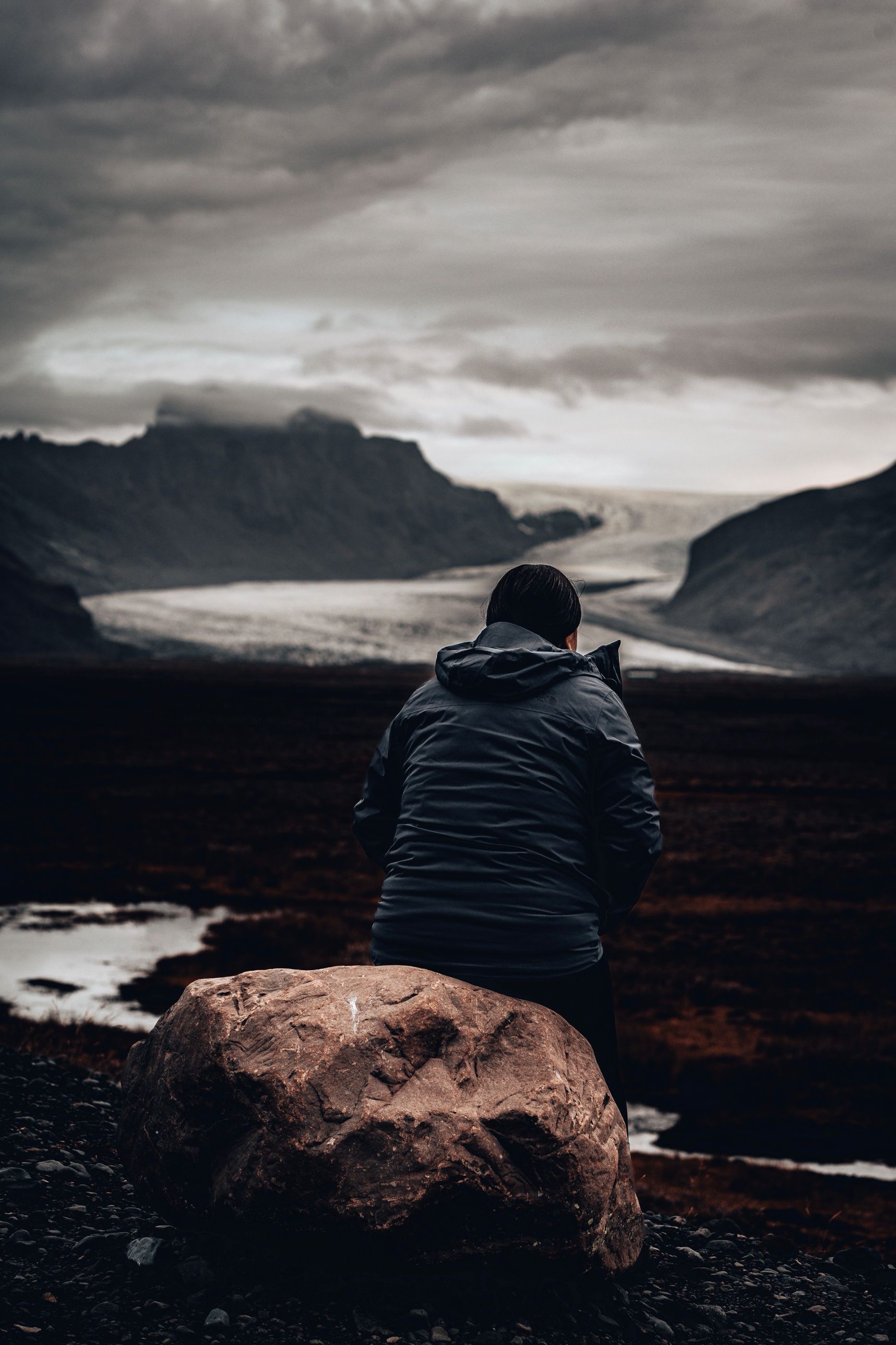
- Skaftafell: the hiking hub of Skaftafell in Vatnajökull National Park has marked trails from the visitor centre. The easy 5.8 km Svartifoss–Sjónarsker–Sel loop takes about two hours. Sjónarnípa (6.5 km, 2–2.5 hours) looks straight onto Skaftafellsjökull, and the 16.6 km Skaftafellsheiði loop takes 5–6 hours.
- Landmannalaugar: short, steep climbs to Bláhnúkur (about 945 m) and Brennisteinsalda give views over striped rhyolite mountains and steaming vents. You need a 4x4 or the highland bus to get there. See our Landmannalaugar hiking guide.
- Glymur: Iceland's second-highest waterfall drops 198 m into a canyon in Hvalfjörður, north of Reykjavík. The loop is about 7 km with 425 m of climbing and takes 3–4 hours. It follows the canyon edge and crosses the river on a log, which is usually only in place from spring to autumn.
- Mount Esja: about 10 km north of Reykjavík, Esja is the capital's home mountain. The marked path climbs roughly 600 m to Steinn, a large rock where most people turn round. Experienced hikers continue to Þverfellshorn at 780 m.
- Hengifoss: in the east, a steep path climbs about 300 m past the basalt columns of Litlanesfoss to Hengifoss, a 128 m waterfall in a gorge banded with red clay. Allow about two hours return.
What are the easiest hikes in Iceland?
The easiest hikes in Iceland are short, well-made paths to waterfalls, canyons and craters. Good examples are the stairs beside Skógafoss, the rim path at Fjaðrárgljúfur, the walk to Svartifoss, the 20 to 30-minute climb up Hverfjall crater at Mývatn and the walk to the Reykjadalur hot river. Most take under two hours and start from a car park on or near the Ring Road. Our list of easy hikes in Iceland has times and tips for each.
Can you hike on a glacier in Iceland on your own?
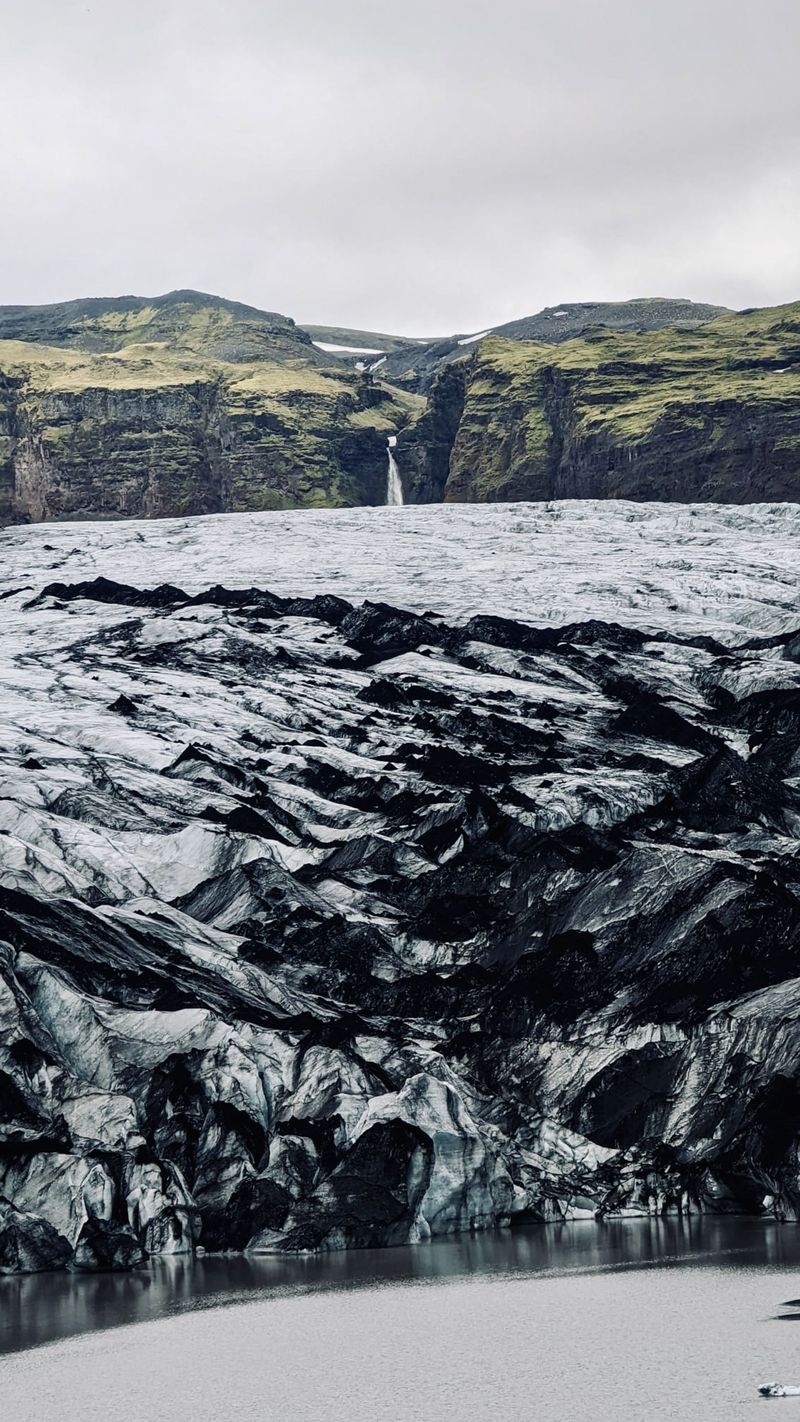
No, you should only walk on a glacier with a qualified guide. Glacier ice hides crevasses and meltwater channels that change from week to week, and you need crampons, an ice axe and the skills to use them. Guided hikes run all year at Sólheimajökull and in Skaftafell. You can walk to the edge of Sólheimajökull on your own, but stop at the ice. Our glacier hiking guide explains how the tours work, Most tours start from the Skaftafell visitor centre or the Sólheimajökull car park.
Stay on the path. Iceland's moss and soil take decades to recover from footprints. Stay on marked trails, camp only where it is allowed, and carry out all your rubbish, including food scraps and toilet paper.
How do you get to Iceland's hiking trails?
Most lowland trailheads have a car park beside a paved or gravel road, and a normal car is fine in summer. Many charge a parking fee, usually paid by app or by camera number-plate reading. The highland trailheads, including Landmannalaugar, are reached by F-roads that only 4x4 vehicles may use, often with unbridged rivers.
If you do not want to drive in the highlands, take the summer highland buses. They run from the BSÍ bus terminal in Reykjavík to Landmannalaugar, Þórsmörk and Skógar, roughly from late June to early September. They are also how most Laugavegur hikers get to the start and home from the end. For the wider picture, see getting around Iceland.
At Landmannalaugar, anyone driving their own car and arriving between 9:00 and 16:00 must book a parking slot in advance. In 2026 the rule applied from 20 June to 13 September, and the fee was ISK 1,500 for a car with up to five seats. Bus passengers do not need to book.
Where do you sleep on a multi-day hike in Iceland?
On the main trails you sleep in mountain huts or at the campsites beside them. FÍ runs the huts on the Laugavegur and many others across the highlands, and Útivist runs huts at Básar in Þórsmörk and on Fimmvörðuháls. The huts have bunks, kitchens with gas stoves and, at most sites, showers, but you bring your own sleeping bag and food.
Huts fill up months ahead for July and August. FÍ sells its Laugavegur nights as route packages, and in 2026 a three-night hut package cost ISK 54,000. Camping is cheaper and easier to book, but you carry more weight and need a tent that stands up to strong wind. On the Laugavegur, camp only at the hut sites.
How do you stay safe hiking in Iceland?
To stay safe hiking in Iceland, check the weather every day, leave a travel plan, stay on marked trails and turn back when conditions turn. The weather changes fast, even in summer. Fog can hide the trail markers within minutes, and wind is the biggest danger on exposed passes.
- Check the forecast at vedur.is once or twice a day, and ask hut wardens and rangers, who know the local conditions.
- Leave a travel plan at safetravel.is and with someone at home, and update it if your plans change.
- Carry navigation: a GPS or phone with offline maps, a paper map and compass, and a power bank.
- Know about rivers: glacial rivers are lowest in the morning and rise after rain and on warm afternoons. Cross in groups of two or three with linked arms, in sandals or old trainers, and never cross if you are unsure.
- Watch for hypothermia: SafeTravel says it is common in Iceland even in summer. Change into dry layers early and keep eating.
- Call 112 in an emergency. Phone coverage in the highlands is patchy, so for remote routes consider renting a personal locator beacon or satellite messenger.
How fit do you need to be to hike in Iceland?
You need average fitness for the short walks and good fitness for the full-day hikes and treks. The easy trails in this guide suit most people who can walk for an hour or two on uneven ground. A day like Glymur or Bláhnúkur needs you to climb 300 to 400 m on steep, loose paths. The Laugavegur asks for four days in a row of four to seven hours' walking with a full pack, often in wind and rain.
SafeTravel's advice is simple: be honest about your experience, fitness and equipment, start with easier routes, and keep daily distances reasonable. If you have never carried a pack for several days, try a weekend trek at home first, or join a guided group.
Can you hike in Iceland in winter?
Yes, but only on lowland trails, and with winter gear. From about November to April, paths at places like Fjaðrárgljúfur and Skaftafell are often icy, so microspikes or crampons are essential. Daylight is short, and around the December solstice Reykjavík has only about four hours of it. Some trails close in the spring thaw, roughly March to May, to protect the wet ground.
The highland trails are a different matter. The huts are locked, the F-roads are closed and FÍ says winter crossings of routes like the Laugavegur need expert skills and full winter equipment. In winter, the best way into the mountains is a guided tour: glacier hikes and ice caves run with qualified guides through the cold months.
Do you need a guide to hike in Iceland?
You do not need a guide for marked trails in summer, and many people walk the Laugavegur on their own each summer. A guide makes sense on glaciers, where it is essential, on remote routes like Hornstrandir if you lack wilderness experience, and on any route under a warning, such as Fimmvörðuháls in 2026. Guided treks also solve the logistics, with huts, food and transport booked for you.
What should you pack for hiking in Iceland?
Pack for wind, rain and cold on every hike, whatever the season. That means a waterproof jacket and trousers, warm wool or fleece layers, a hat and gloves, sturdy waterproof boots and enough food and water. For hut trips, add a sleeping bag; for river crossings, light shoes you can wade in. Our full Iceland hiking packing list covers day hikes, hut treks and camping.
How should you plan your first hiking trip in Iceland?
Start with day hikes from a car or a base, then add a highland trek once you know how you handle the weather. A good first week combines the south coast walks with a few days in Skaftafell, or a day trip to Landmannalaugar by bus. Book huts and buses for July and August as early as you can, and keep a spare day in case a storm closes a pass.
For more ideas beyond the trails, browse our Iceland highlights with their interactive map. Our printed Summer guidebook brings the main hikes, huts and highland roads together in one place for the trip.
Facts checked October 2026. Hut prices, bus timetables and parking rules change every year, and highland trails open only when the snow and roads allow. The Fimmvörðuháls warning was issued on 25 August 2026; check fi.is and safetravel.is for its current status.
Sources
- Trails: Laugavegur (Ferðafélag Íslands)
- Warning: dangerous conditions on the Fimmvörðuháls hiking trail (Icelandic Tourist Board)
- Svartifoss and Skaftafell trails (Vatnajökull National Park)
- Ásbyrgi to Dettifoss: Canyon Trail (Vatnajökull National Park)
- The ultimate guide to Hornstrandir (Westfjords.is)
- Hiking and trekking (SafeTravel)
- Glymur waterfall hike guide (Earth Trekkers)
- Landmannalaugar parking (Parka)