The best photo spots on the Golden Circle are the Hakið viewpoint and the Almannagjá gorge at Þingvellir, Öxarárfoss waterfall, the Strokkur geyser at the moment it erupts, the upper viewpoint and lower path at Gullfoss, and the rim of Kerið crater. Low sun suits most of them, which means early mornings and late evenings in summer and the whole short day in winter. Here is where to stand, when to go and what the rules are for drones.
Where are the best photo spots at Þingvellir?
Start at the Hakið viewpoint by the visitor centre. It looks east over the rift valley towards Þingvallavatn lake and the small church, and shows the scale of the place better than anywhere else. With the view facing east, the late afternoon and evening light falls on the valley from behind you.
- Almannagjá. Walk down into the gorge for the classic shot of the path running between the fault walls. Use a wide lens and include a person for scale. Low sun throws long shadows across the rock.
- Öxarárfoss. The Öxará river drops over the Almannagjá cliff into the gorge. It is a short walk from the P2 car park. In winter it partly freezes.
- Þingvallakirkja and the farmhouse. The small church and the old farm buildings make a tidy frame with the rift behind.
- Flosagjá and Peningagjá. Water-filled fissures with very clear water. Shoot from the marked paths.
Arrive before 9.00 or after 17.00 to have the gorge mostly to yourself. Read more in our Þingvellir National Park guide.
How do you photograph Strokkur erupting?
Pick your spot, frame wide and use burst mode. Strokkur usually erupts every five to ten minutes, and each eruption lasts only a couple of seconds. Watch the pool: the water sinks and swells, then a turquoise dome bulges up from the vent a split second before the blast. That bubble is the shot.
- Light behind the eruption. With the sun behind the water column, the spray and steam glow. On a sunny winter day, the low sun backlights it for much of the day.
- Stand upwind. The spray falls as a warm, mineral-heavy shower and dries into spots on your lens.
- Give it three or four eruptions. The first is for watching; by the third you know when to press.
- Try video. A short clip often catches the bubble better than a still.
Cold, still days give the tallest steam columns. Stay behind the ropes at all times: the water is close to boiling. Our Geysir and Strokkur guide has more.
What are the best angles at Gullfoss?
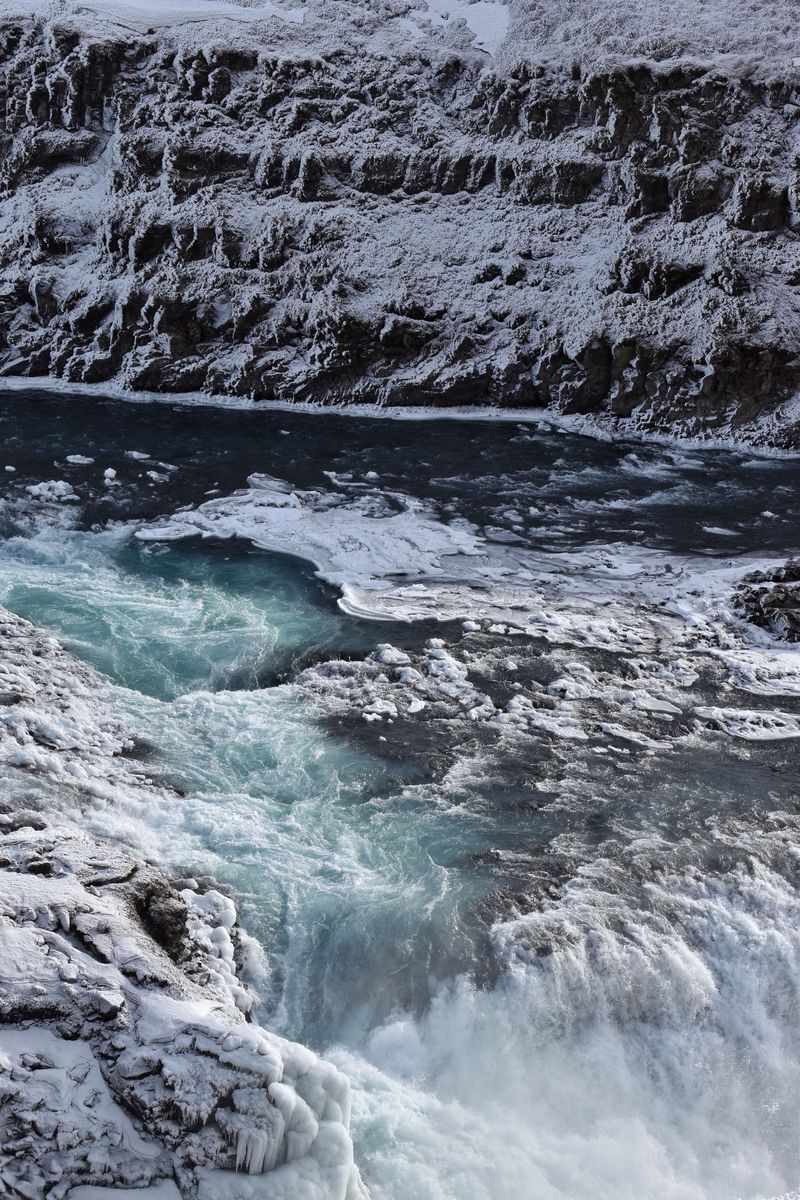
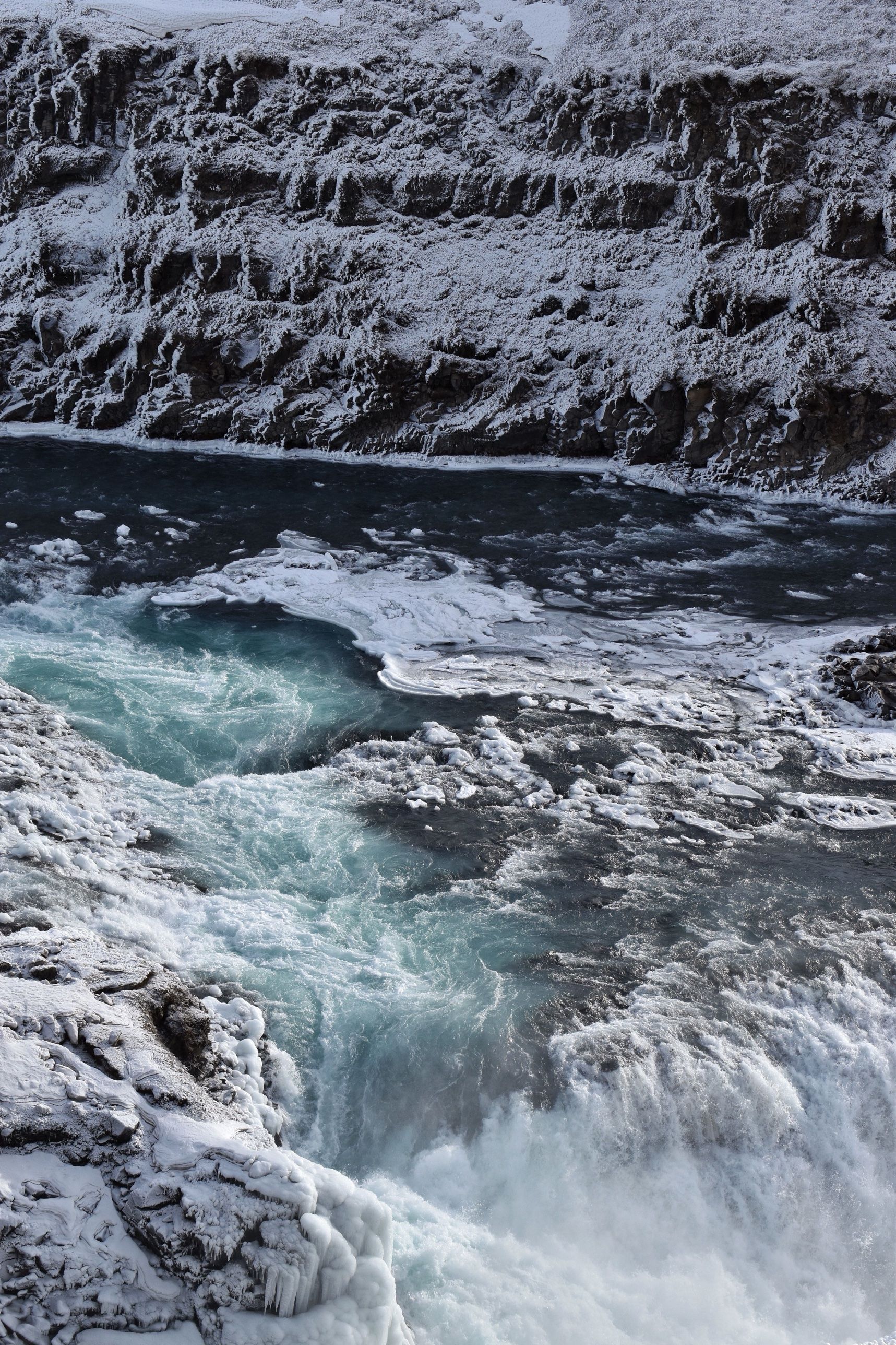
Use the upper viewpoint for the whole scene and the lower path for drama. Gullfoss drops 32 metres in two tiers into a long canyon, and no single angle shows everything.
- Upper viewpoint. Near the café on the rim. It shows both tiers and the canyon, and it is drier. A wide lens gets the classic composition.
- Lower path. Stairs lead down to a path along the rim and out to a rocky spur beside the first tier. It is louder, closer and much wetter. A person on the spur gives scale. It is often closed by ice in winter.
- Rainbows. They form in the spray when the sun is behind you. In winter, the low midday sun gives the best chance.
Keep a cloth in your pocket and shoot between gusts of spray. Tripods are fine on the paths if you keep them out of other people's way. In summer, before 10.00 or after 16.00 is quieter.
How do you photograph Kerið crater?
Kerið is a volcanic crater about 55 metres deep, with red and black walls and a green-blue lake at the bottom. The northern viewpoints give the classic composition of the red wall with the lake below. The eastern side is the highest point, with a wide view over the Grímsnes lava field.
Midday gives the strongest colour in the water. Early morning and late afternoon give softer light on the red rim. Walk down the stairs to the lake for a different view: from the bottom, the crater wall looks far bigger than it does from above.
Kerið is open in daylight, roughly 08.00 to 21.00 in summer and 10.00 to 17.00 in winter, and charges a small entry fee. Flying drones over the lake is prohibited. See the Kerið place page.
Which smaller stops are good for photos?
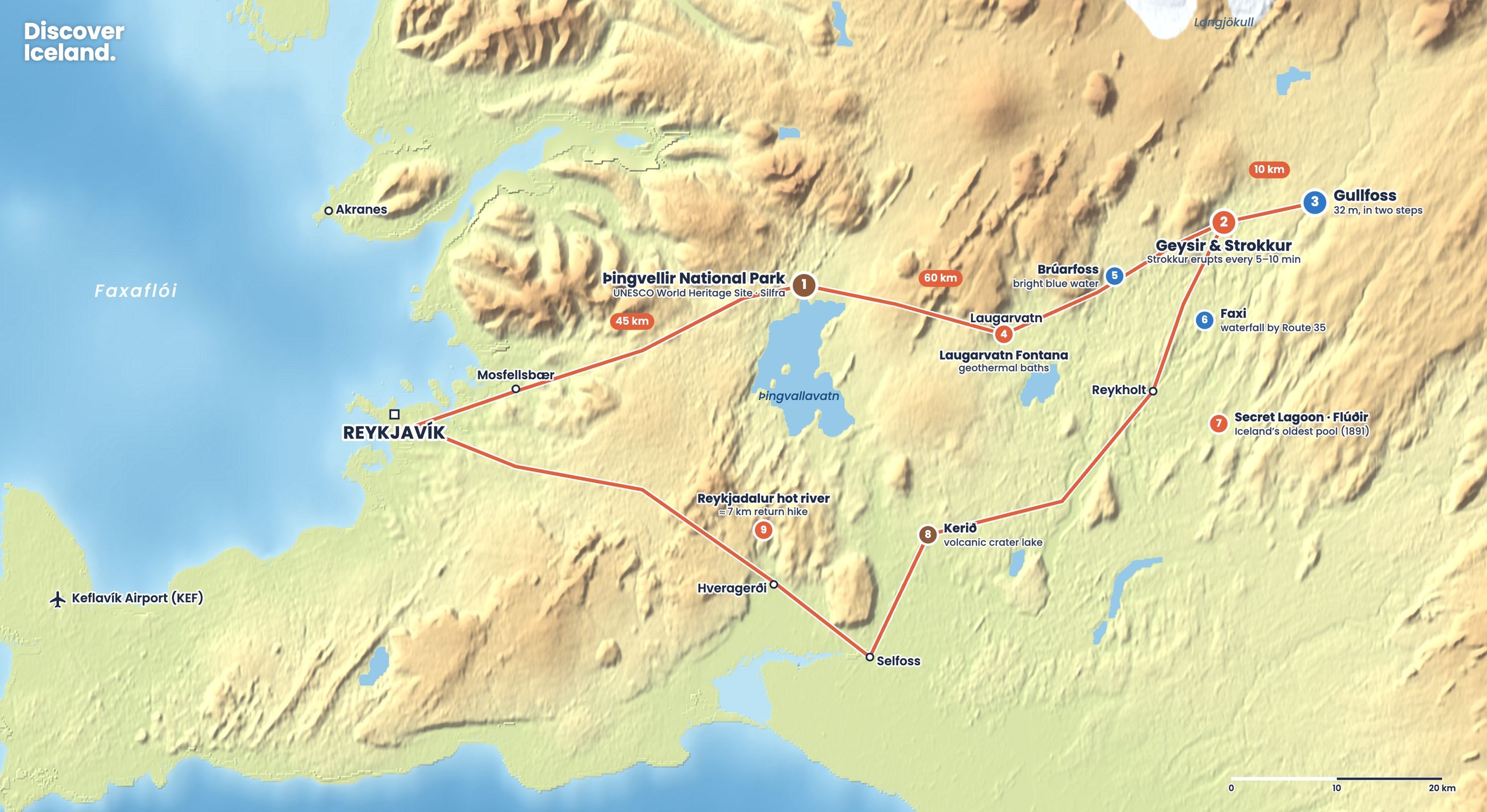
- Faxi. A low waterfall, only about 7 metres high but around 80 metres wide, 11 km south of Geysir. Use a wide lens. Summer adds green grass and lupins in the foreground; rainbows can appear in the mist on sunny mornings.
- Brúarfoss. A small waterfall with bright blue water between Laugarvatn and Geysir. A paid car park lets you reach it in about five minutes on foot.
- Geysir hillside. A short climb up the slope behind the hot springs gives a view down over the steaming field.
When is the best light on the Golden Circle?
Low sun is best, and when you get it depends on the month. Here is how the seasons compare in Reykjavík:
| Season | Daylight | Best for |
|---|---|---|
| June–July | About 18–21 h; sunset near midnight in late June | Late-evening light with almost no people |
| August–September | About 18 h falling to under 12 h | Golden evenings, autumn colour, first dark nights |
| October–March | About 4–11 h | Low sun all day, snow, frozen falls, aurora |
| April–May | About 13–20 h | Long days, fewer people, snow on the hills |
In midwinter the sun stays low for the whole short day, so you get long shadows and warm light even at noon. In summer you have to work late: the best light at Þingvellir and Kerið comes after 20.00. Our Golden Circle in summer guide has an evening plan.
Can you fly a drone on the Golden Circle?
Only with care, and often not at all. At Þingvellir, drones may not fly over the most visited area, from the service centre to the lake, including Almannagjá, Öxarárfoss, the church and Silfra, between 09.00 and 18.00. Outside those hours, and elsewhere in the park, you must respect other visitors and wildlife.
Geysir and Gullfoss are protected areas. Recreational drone flights in protected areas need a permit from Iceland's nature agency, which takes about 15 days to process and carries a fee. At Kerið, drones are banned over the lake. Check the national drone rules with the Icelandic Transport Authority before you fly anywhere.
What should photographers know before driving the Golden Circle?
- Never stop on the road for a shot. Use car parks and lay-bys only.
- Protect your gear. Spray at Gullfoss and Strokkur is constant, and the minerals at Geysir leave spots.
- Stay on the paths. At Þingvellir the moss is fragile and fissures can be hidden; at Geysir the ground near the vents is scalding.
- Plan for aurora. From about September to mid-April, the dark sky at Þingvellir is good for the northern lights. See our Golden Circle at night guide.
For the route and fees, read the main Golden Circle self-drive guide, and for waterfall technique, our guide to photographing Iceland's waterfalls. See the place pages for Þingvellir and Gullfoss.
Facts checked October 2026. Drone rules, opening hours and paths that close for ice change; check with each site and with Náttúruverndarstofnun and the Icelandic Transport Authority before flying.
Sources
- Drone flying for personal use (Þingvellir National Park)
- Photography, cinematography and drone flying in protected areas (ust.is)
- Complete guide to Þingvellir (Golden Circle Day Tours)
- 13 things to know before visiting Gullfoss (Golden Circle Day Tours)
- Kerið entrance fee and hours (Golden Circle Day Tours)
- Kerið (Arctic Adventures)
- Faxi waterfall (Go Campers)
- Iceland daylight hours (Go Campers)