Summer is the easiest time to drive the Golden Circle, and the busiest. The roads are clear, every path is open and, around the June solstice, the sun sets in Reykjavík just after midnight. The trick is to use that light: start in the afternoon, eat in the middle of the day, and reach Þingvellir and Kerið in the evening when the coaches have gone. Here is how to plan a summer day, what is open late, and the summer-only extras worth adding.
What is the Golden Circle like in summer?
From June to August, the Golden Circle is green, open and busy. All the main paths are open, including the lower path at Gullfoss, which often closes in winter. Laugarvatn, Flúðir and Reykholt are full of visitors, and the tour coaches run all day.
The big difference is the light. On 21 June, the sun rises in Reykjavík at about 2.55 and sets at about 0.03, giving just over 21 hours of daylight. Even after sunset, the sky stays light all night. In July days are still 18 to 21 hours long, and by late August they are down to about 14 to 15.
How do you beat the crowds on the Golden Circle in summer?
Go late. The tour coaches leave Reykjavík in the morning and are mostly heading home by late afternoon. Þingvellir is quiet after about 17.00, Gullfoss after 16.00 and Kerið after 16.00. Geysir is busiest from late morning to mid-afternoon.
The alternative is to go very early, before 9.00 at Þingvellir. But late is easier in summer: you can sleep in, the light is better, and there is no rush to get back before dark.
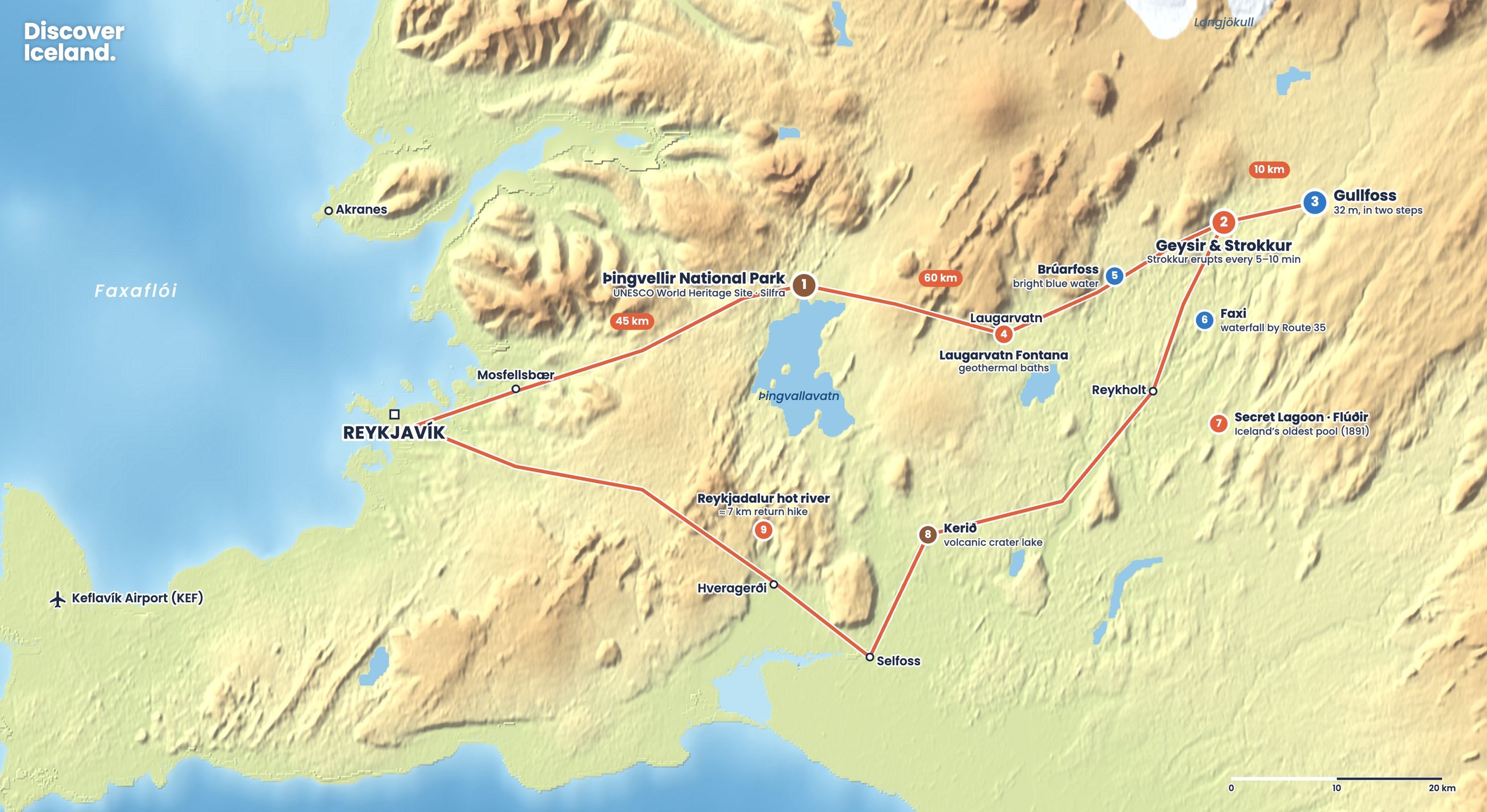
What does a late-evening summer Golden Circle look like?
Drive the loop anticlockwise and finish at Þingvellir in the evening light. This plan works from late May to early August.
- 12.00 Leave Reykjavík on Route 1 towards Selfoss.
- 13.00 Kerið. A quick walk around the crater rim. The coaches may be there, but it takes only 30 minutes.
- 14.00 Friðheimar or the Secret Lagoon. A late tomato soup lunch (the kitchen closes at 16.00), or a soak in Flúðir's old pool.
- 16.30 Gullfoss. The coaches have mostly gone. Walk both paths.
- 17.30 Geysir. Watch Strokkur with a much smaller crowd.
- 19.00 Dinner in Laugarvatn. Lindin is open until 22.00.
- 20.30 Þingvellir. Walk Almannagjá to Öxarárfoss in low, warm light, often almost alone.
- 22.30 Back in Reykjavík, still in daylight in June.
All three main sights are open in the evening: Þingvellir is open around the clock, the Geysir area day and night, and the Gullfoss paths at all hours. Kerið, which charges entry, is open roughly 08.00 to 21.00 or 22.00 in summer.
Can you snorkel Silfra in summer?
Yes, and summer is the most popular time. Silfra is a fissure at Þingvellir filled with glacial meltwater that has filtered through lava for decades, giving visibility often quoted at more than 100 metres. You snorkel in a drysuit with a licensed operator.
The water is 2–4°C all year, so summer only warms the air, not the water. Snorkelling starts from about ISK 19,990 with one operator, plus a ISK 1,500 national park fee per person. Operators check swimming ability and health. Book ahead from June to August, when Silfra is at its busiest. Details are in our Þingvellir National Park guide.
What summer-only extras are there on the Golden Circle?
Some of the best extras only run, or only open fully, in the warmer months.
- Free ranger walks at Þingvellir. Daily from June to August, in English, at 10.00 from Þingvallakirkja and 14.00 from the Hakið visitor centre. No booking needed.
- Horses at Friðheimar. The farm's horse show runs in summer only and is aimed at pre-booked groups. You can usually see the horses in the paddock by the car park for free.
- Horse riding at Efstidalur. The farm's horse rental runs in summer only.
- Við Faxa. The seasonal restaurant by Faxi waterfall, with a patio facing the falls. Salmon use the ladder beside the falls, with the migration peaking in late July and August.
- Camping. Þingvellir's campsites at Leirar and Vatnskot are open mainly in summer. Never camp or park a campervan overnight outside a campsite.
What is open late on the Golden Circle in summer?
| Place | Summer hours |
|---|---|
| Laugarvatn Fontana | 10.00–21.00 (1 June to 30 September) |
| Secret Lagoon | 10.00–20.00 (1 June to 30 September) |
| Kerið | About 08.00–21.00 or 22.00 |
| Lindin, Laugarvatn | 12.00–22.00 |
| Vínstofa Friðheima | 12.00–22.00; kitchen to 21.00 |
| Þingvellir visitor centre | 09.00–18.00 |
Book Friðheimar, Fontana and the Secret Lagoon ahead in July and August. They are small, and tour groups take many of the slots.
Is summer the best time to drive the Golden Circle?
For an easy, relaxed drive, yes. The roads are clear, every path is open, and you can stay out as late as you like. The lower path at Gullfoss, often closed by ice from November to March, is open, and the free ranger walks run at Þingvellir.
The trade-offs are crowds, busier car parks and the need to book. Silfra is at its busiest, and the small restaurants and pools fill with tour groups. If you prefer snow, frozen waterfalls and the chance of auroras, winter is the better season. Compare the two with our Golden Circle in winter guide.
Can you see the northern lights on the Golden Circle in summer?
No. From late May to July the sky never gets dark enough. The aurora season starts again in late August and September, when the nights draw in. If the northern lights matter to you, read our northern lights guide and plan for autumn or winter instead.
What should you know about the midnight sun on the Golden Circle?
- Watch the clock, not the sky. It is easy to keep driving at 23.00 because it looks like late afternoon. Stop when you are tired.
- Bring a sleep mask. Countryside hotels and campsites stay light all night.
- Pack for rain anyway. Summer weather is mild but changeable. Bring a waterproof jacket, especially for the spray at Gullfoss.
- Keep your headlights on. In Iceland they must be on at all times, even in bright daylight.
- Never stop on the road for photos. Summer traffic makes this even more dangerous.
For the classic daytime loop, see our main Golden Circle self-drive guide, and for a quick trip, the Golden Circle in half a day. For more on the season, read the best time to visit Iceland. See the place pages for Þingvellir, Gullfoss and Kerið. Our Summer edition, one of our printed guidebooks, has the loop with maps.
Facts checked October 2026. Sunrise and sunset times are for Reykjavík; opening hours, ranger walk times and Silfra prices change each season. Confirm with each operator and check vedur.is before you drive.
Sources
- Sunrise and sunset in Reykjavík, June (timeanddate.com)
- Iceland daylight hours (Go Campers)
- Guided walk with a ranger (Þingvellir National Park)
- Snorkeling and diving in Silfra (Dive.is)
- Tourist services (Friðheimar)
- Hours and prices (Laugarvatn Fontana)
- Secret Lagoon hours and prices (Golden Circle Day Tours)
- Family fun parks and farms (Visit South Iceland)