At Geysir, in the Haukadalur valley on the Golden Circle, you can watch the Strokkur geyser shoot boiling water 15 to 20 metres into the air every few minutes. The famous Great Geysir beside it, which gave its name to geysers everywhere, rarely erupts today. Entry is free and the area is open all the time. Plan 30 to 60 minutes, and stand upwind.
How often does Strokkur erupt?
Strokkur usually erupts every five to ten minutes, and sometimes you wait up to 15. Most eruptions reach 15 to 20 metres. Now and then it fires a double or triple burst, and the biggest eruptions have been reported at well over 30 metres.
Watch the pool before it goes. The water sinks and swells, then a turquoise dome of water bulges up from the vent a split second before the blast. That bubble is the moment photographers wait for. Strokkur was first described in 1789, stopped erupting in the early 1900s, and was revived in the 1960s when its vent was cleared.
Does the Great Geysir still erupt?
Only rarely. The Great Geysir is the original geyser, and the word comes from its Icelandic name. In its active periods it threw water up to about 60 metres, but its activity has always come and gone, often revived by earthquakes and then fading again.
After earthquakes in 2000 it erupted to a reported 122 metres for two days. Its activity faded again in the following years, and an eruption in 2016 made the news because it was so unusual. Today you see a wide, steaming, blue pool about 50 metres north of Strokkur. Do not expect an eruption, but it is worth seeing.
What else is there to see at Geysir?
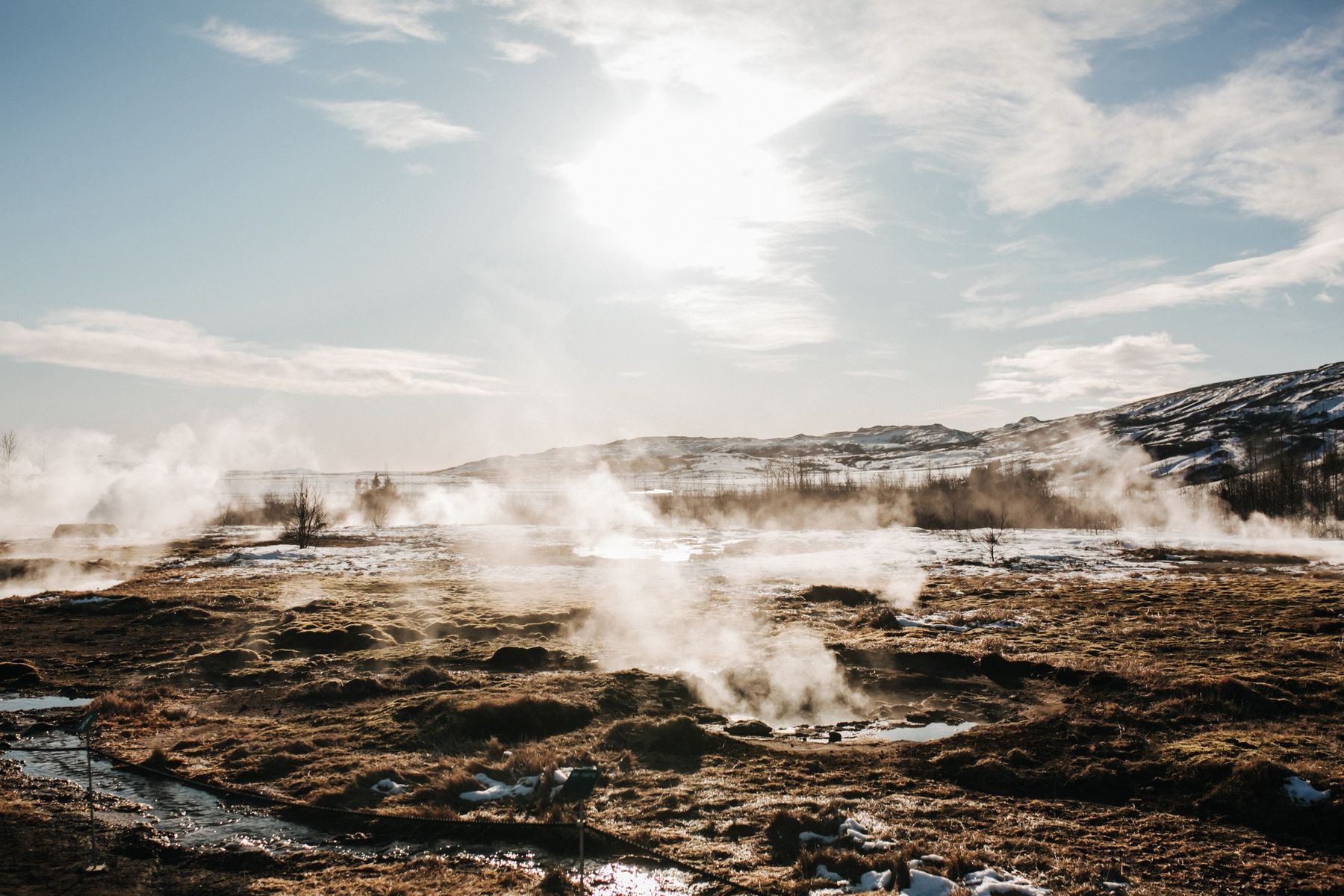
The Haukadalur geothermal area has about thirty smaller hot springs and pools around the two main geysers. A loop of paths leads past steaming vents, blue pools, bubbling mud and ground stained red and yellow by minerals.
- Litli Geysir: "Little Geysir", a small spring that bubbles and splashes constantly.
- Blue pools: clear, steaming pools with vivid blue water, best seen on a sunny day.
- The hillside path: a short climb up the slope of Laugarfjall gives a view down over the field and the valley.
The area has been officially protected since 17 June 2020. The land has a long history of private ownership: in 1894 it was sold to a private buyer who charged visitors entry, and in 1935 it was bought and given to the Icelandic people.
Is Geysir dangerous?
It can be if you ignore the ropes. The water at the surface of the vents is around 90–95°C, and much hotter deeper down. The thin crust of ground near the pools can break. Visitors have been burned after stepping off the path or putting a hand in the water.
- Stay behind the ropes and on the marked paths at all times.
- Never touch the water or throw anything into the vents.
- Stand on the upwind side of Strokkur. The spray is hot when it leaves the vent and falls as a warm, mineral-heavy shower.
- Keep children close, and hold their hands near the rope line.
- In winter the paths can be very icy around the vents. Wear ice cleats.
How much does it cost to visit Geysir?
Entry to the Geysir area is free. You pay for parking, about ISK 1,000 for a normal car, through the Parka app or the signs on site. The area is open day and night, all year.
Across Route 35 is a large visitor complex with a hotel, cafés, a restaurant, a souvenir shop and toilets.
When is the best time to visit Geysir?
Early morning or late afternoon is best, when the tour coaches have gone. Geysir is busiest from late morning to mid-afternoon, and a crowd can form a deep ring around Strokkur.
A sunny, cold day is ideal: the steam stands out against a blue sky and the pools look their bluest. In winter, low sun lights the steam from behind, and the field is often white with frost. On calm winter nights, the steam and the dark sky make a strange setting for the northern lights.
How long should you spend at Geysir?
Plan 30 to 60 minutes for the hot spring area itself. That is enough to see Strokkur erupt several times, walk the loop past the Great Geysir and the smaller pools, and climb a little way up the hillside for the view. Add 45 minutes to an hour if you are having lunch across the road. If the car park is full and the crowd around Strokkur is deep, walk the outer paths first and come back to the main viewing ring after the next coach leaves.
Geysir is the natural middle of a Golden Circle day. Most people arrive from Þingvellir in the late morning, eat here, and drive the ten minutes to Gullfoss in the early afternoon.
Can you stay overnight near Geysir?
Yes. There is a hotel by the geothermal area and a seasonal campsite with electric hook-ups, toilets and showers. Staying close means you can walk over to Strokkur in the early morning or late evening, when the field is almost empty and the light is low. Remember that campervans and tents must use an organised campsite; overnight stays in car parks are not allowed.
How do you photograph Strokkur?
- Use burst mode. Eruptions last only a couple of seconds. Hold the shutter as the dome rises.
- Find the light. With the sun behind the eruption, the water and steam glow.
- Frame wide. The steam cloud is often bigger than the water column, so leave room above.
- Try video. A short clip often captures the bubble better than a single still.
- Protect your lens. Mineral-rich spray dries into spots. Wipe it off quickly.
How do you get to Geysir, and what is nearby?
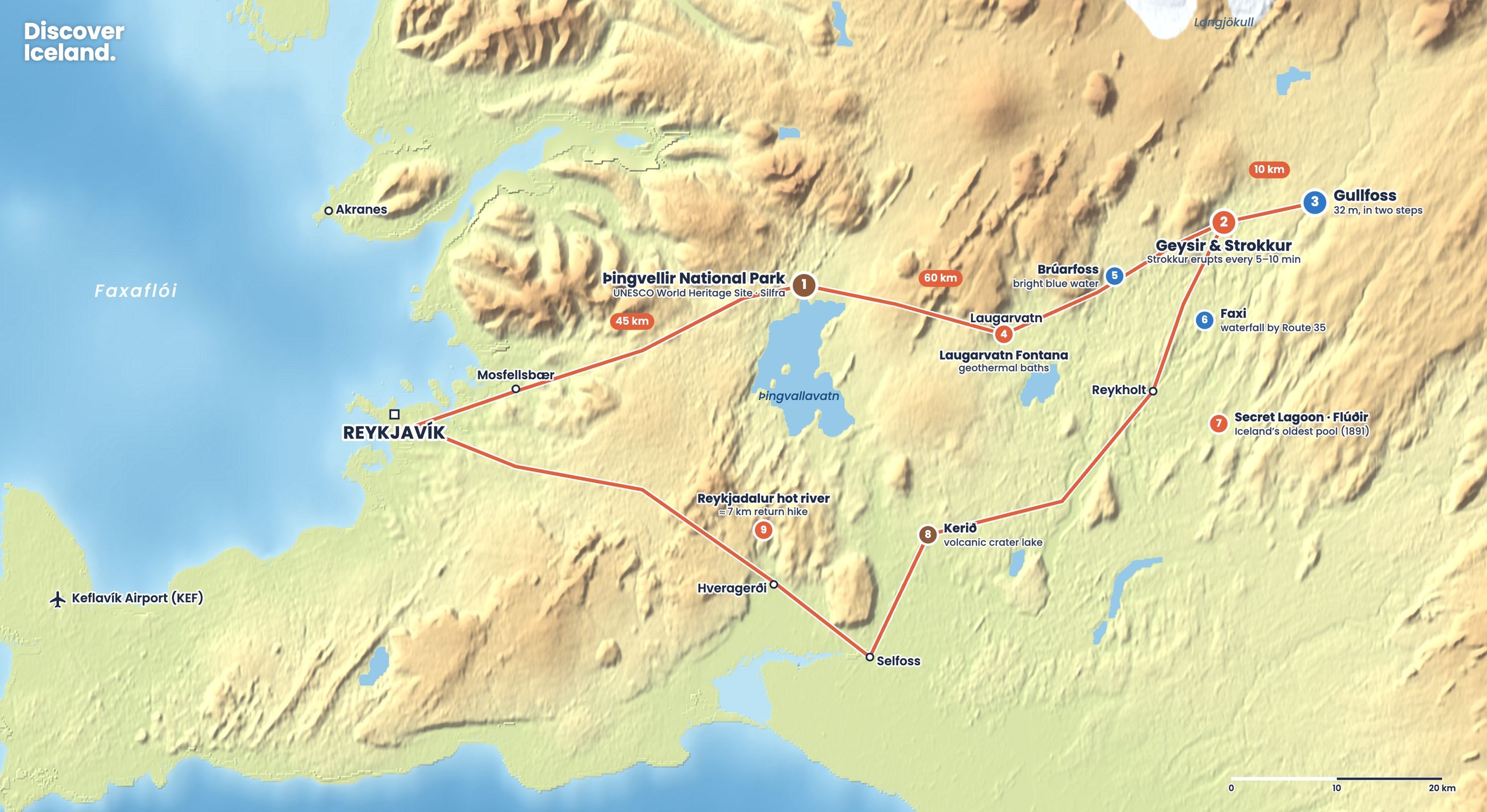
Geysir is about 100 km from Reykjavík, roughly 1 hour 30 minutes by the shortest route. On the Golden Circle loop you usually come from Þingvellir via Laugarvatn, about 60 km and 50 minutes away. Gullfoss is only about 10 km further on Route 35.
Nearby extras include Faxi waterfall, about 11 km south, the Friðheimar tomato greenhouse at Reykholt, and the Secret Lagoon at Flúðir, which is fed by its own small geyser. See our guide to extra Golden Circle stops, the full Golden Circle self-drive guide, and the Geysir place page for photos.
Give Strokkur three or four eruptions. The first one surprises you; by the fourth you know when to press the shutter.
Facts checked October 2026. Strokkur's activity varies over time, and parking charges and payment apps change; check the signs on site.