Yes, it is generally safe to visit Iceland during an eruption. The recent eruptions have all been on the Reykjanes Peninsula, they affect a small area near Grindavík, and Keflavík Airport has kept operating throughout. The risks are local: volcanic gas, fresh lava, sudden closures and, for the glacier volcanoes, floods and ash. This guide explains each one and the official sources to check.
As of mid-October 2026 no eruption is under way in Iceland. The Met Office expects another eruption on the Reykjanes Peninsula at some point, so read this before you travel.
Is it safe to travel to Iceland during an eruption?
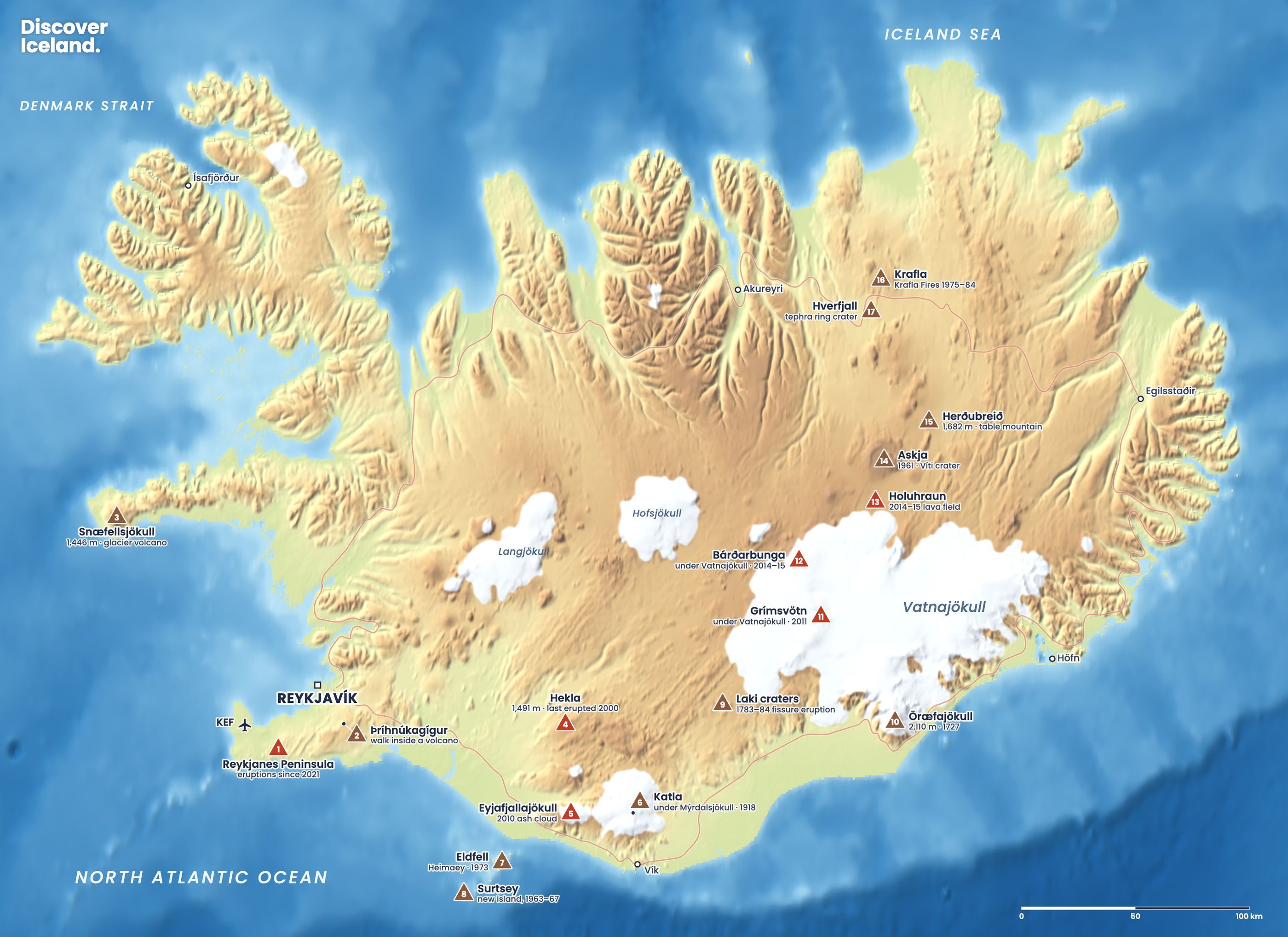
For almost all visitors, yes. The eruptions since 2021 have been fissure eruptions: long cracks that pour out lava and gas but very little ash. Each one has been confined to a few square kilometres of the Reykjanes Peninsula, south-west of Reykjavík. The rest of the country, from the Golden Circle to the glacier lagoons, carries on as normal.
Iceland's volcanoes are monitored around the clock by the Icelandic Met Office. When magma starts to move, the civil protection authorities close roads and evacuate the area, often before the eruption begins. The people who get hurt are usually those who ignore closures or walk onto new lava.
Will a volcano affect my flight to Iceland?
Probably not. Keflavík Airport says it has kept a normal schedule throughout the Reykjanes eruptions, even though it is only about 20 km from the eruption zone. These eruptions produce little ash, which is what grounds aircraft.
Ash-rich eruptions under glaciers are different. When Eyjafjallajökull erupted in April 2010, most European airspace closed from 15 to 20 April and about 10 million travellers were affected. The Grímsvötn eruption in May 2011 disrupted about 900 flights at first. That kind of disruption is rare, but it is why travel insurance that covers natural events and flexible bookings is worth having.
| Type of eruption | Example | Main hazard | Effect on travellers |
|---|---|---|---|
| Fissure eruption on land | Reykjanes, 2021–25 | Lava, gas | Local closures; flights normal |
| Eruption under a glacier | Eyjafjallajökull 2010, Grímsvötn 2011 | Ash, glacial floods | Possible flight disruption; road closures |
| Explosive stratovolcano | Hekla 2000 | Ash, sudden onset | Closures in the area; hikers at risk |
| Highland fissure eruption | Holuhraun 2014–15 | Gas over wide areas | Highland closures; air quality alerts |
How dangerous is volcanic gas?
Volcanic gas is the most underestimated risk near an eruption. Gases such as sulphur dioxide and carbon dioxide can be invisible and odourless, and they collect quickly in valleys and hollows when the wind drops. They can affect you long before you see any lava.
- Check the gas forecast on vedur.is and live air quality at loftgaedi.is before visiting an eruption area.
- Stay on high ground, ridges and hills, and keep the wind at your back.
- Children under 12 are not advised to visit when gas pollution is present, and visits should be kept to about 15 minutes when levels exceed safety limits.
- Leave dogs behind. The gas and fluorine pollution is unsafe for them.
- If you have asthma or a heart or lung condition, take extra care and stay indoors if you feel symptoms.
- Leave at once if you get a headache, a sore throat or shortness of breath.
Gas can also drift to towns far from the eruption. When the Met Office warns of gas pollution in your area, keep windows closed and limit hard exercise outdoors.
What are the dangers near fresh lava?
The biggest danger is walking on it. New lava can look solid while it is still molten beneath a thin crust, and that crust can break without warning. Never step on lava from a recent eruption.
- Lava edges can collapse or start moving again, so keep well back.
- New fissures can open with little warning near an active area. On Reykjanes, warning times have been as short as about 20 minutes.
- Moss fires can start where lava meets vegetation, adding smoke to the gas.
- Weather is a hazard in its own right. The trails are exposed, and wind, rain and early darkness make them harder than they look.
Stay on marked paths, never cross a closure, and turn back if the gas, weather or light gets worse. Rescue teams are volunteers who come out to people who ignored the same advice.
What closes during an eruption on Reykjanes?
Expect closures around the eruption, not across Iceland. During past eruptions the authorities have closed Grindavík and the roads around it, evacuated the Blue Lagoon and changed access to the hiking trails, sometimes within minutes.
Grindavík was evacuated on 10 November 2023 and reopened to the public in July 2025. In its 30 September 2026 assessment the Met Office kept the town in the "considerable" (orange) hazard category. The Blue Lagoon, beside the Svartsengi power station, has closed temporarily during nearby activity. If either is on your plan, check on the day and book with free cancellation. Our Reykjanes volcano guide has the trails, car parks and full eruption timeline.
What about Katla, Hekla and the glacier volcanoes?
The volcanoes under ice bring different risks. When they erupt or when geothermal heat melts the ice, they can send sudden floods, called jökulhlaups, down rivers to the coast.
- Katla, under Mýrdalsjökull, has not had a major eruption since 1918. A flood in July 2011 destroyed the Ring Road bridge over the Múlakvísl river. In August 2026 another outburst flood in the Múlakvísl came with raised conductivity and gas near the river, and the Met Office reported on 1 September that it was subsiding.
- Sólheimajökull, Katla's outlet glacier, has changing conditions at the glacier margin; the Met Office warned of increased hazard there in July 2026. Only walk on Sólheimajökull with a certified guide.
- Hekla can erupt with less than an hour's warning, and the Met Office says it has been inflated beyond its pre-2000 level. Hikers should check vedur.is first and keep in mind that eruptions can be explosive.
On the south coast, obey any road closure or flood warning, even on a sunny day. Our guide to Hekla, Katla and Eyjafjallajökull explains each volcano.
Which official sources should you check?
| Source | What it tells you |
|---|---|
| Icelandic Met Office (en.vedur.is) | Volcanic and earthquake updates, alert levels, gas forecasts, weather warnings |
| SafeTravel (safetravel.is) | Alerts, closures and restricted areas; SMS alerts and travel plans |
| Civil Protection (almannavarnir.is) | Official safety advice and evacuation zones |
| Road conditions (umferdin.is) | Open and closed roads, live |
| Air quality (loftgaedi.is) | Live readings of volcanic gas and other pollution |
| Visit Reykjanes (visitreykjanes.is) | Access to the eruption trails and local attractions |
In an emergency, call 112. Leaving a travel plan with SafeTravel helps rescuers find you if something goes wrong.
How should you plan a trip around volcanic activity?
- Book flexibly. Choose rooms and tours with free cancellation, especially on the Reykjanes Peninsula.
- Buy travel insurance that covers natural events and flight disruption.
- Sign up for SafeTravel alerts before you land, and check the Met Office and SafeTravel every morning.
- Keep a back-up plan for the Blue Lagoon and anything near Grindavík. Reykjavík has plenty of geothermal pools.
- Watch an eruption with a licensed operator, which only runs trips when the authorities allow it.
- Check road conditions on umferdin.is before each drive, as you would anyway; see our guide to getting around Iceland.
Iceland's volcanoes are a reason to visit, not to stay away. For an overview of all 17 on our map, from Reykjanes to Krafla, read our guide to volcanoes in Iceland.
Facts checked October 2026. Volcanic status, closures and hazard zones change quickly; check en.vedur.is, safetravel.is and umferdin.is before and during your trip.
Sources
- Is it safe to visit Iceland? Volcano update (Keflavík Airport)
- Safety information at the eruption sites (Visit Reykjanes)
- Volcanic activity on Reykjanes Peninsula, July 2025 (Icelandic Tourist Board)
- Situation on the Reykjanes Peninsula, 30 September 2026 (Icelandic Met Office)
- News (Icelandic Met Office)
- Monitoring Hekla (Icelandic Met Office)
- 2010 eruptions of Eyjafjallajökull (Wikipedia)
- Mýrdalsjökull (Wikipedia)